Renewing a 2021 mortgage in 2026: the payment jump and four ways to soften it
Thousands of British Columbia homeowners locked in five-year fixed mortgages in 2021, when rates were under 2%. Many of them are renewing now at rates more than twice as high. The balance is lower than when they started, but the payment still jumps.
This guide follows one typical 2021 mortgage through its renewal, shows how much the payment changes at four renewal rates, and compares the main ways to soften it: stretching the amortization, prepaying, choosing a term, and switching lenders.

The example mortgage
In 2021 a buyer took a $600,000 mortgage at 1.89% fixed for five years, amortized over 25 years. The monthly payment was about $2,509. After five years of payments, about $501,000 is left, with 20 years of amortization remaining.
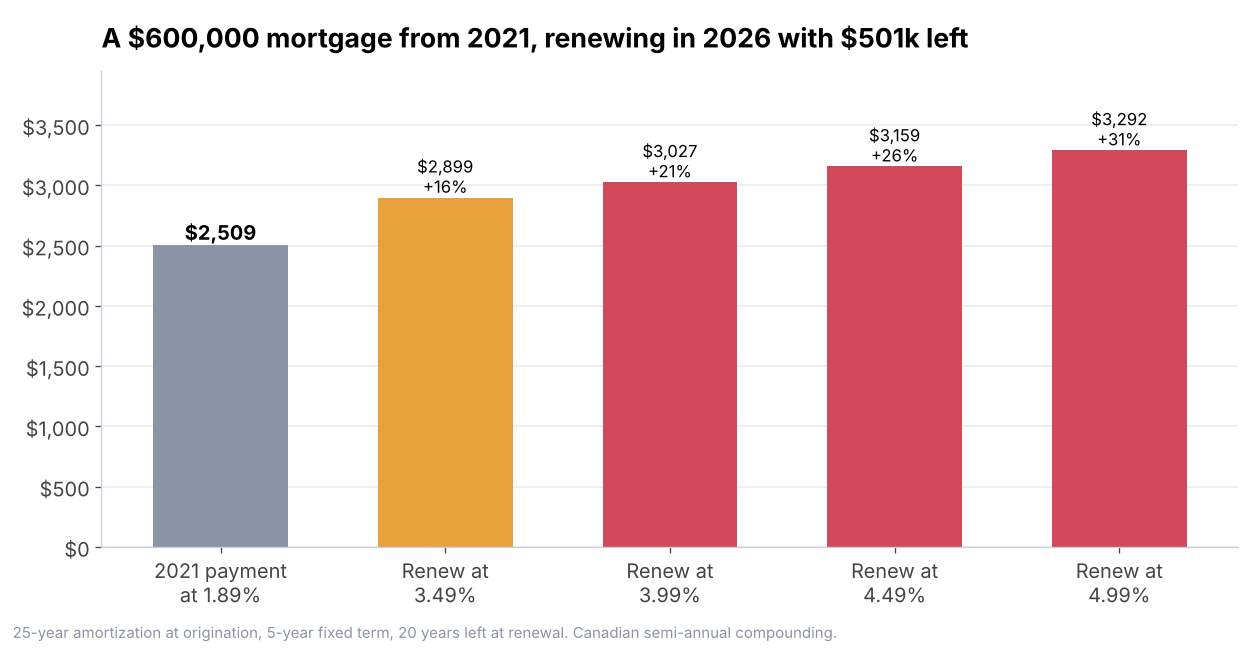
| Renewal rate | New monthly payment | Change from 2021 |
|---|---|---|
| 3.49% | $2,899 | +$390 (+16%) |
| 3.99% | $3,027 | +$518 (+21%) |
| 4.49% | $3,159 | +$650 (+26%) |
| 4.99% | $3,292 | +$783 (+31%) |
The payment rises less than the rate alone would suggest because the balance is $99,000 smaller. But on a household budget, a $500 to $800 monthly increase is real money.
Option 1: reset the amortization
Some lenders will let you renew over a longer amortization, bringing the remaining term back to 25 years, or 30 for some uninsured mortgages. That lowers the payment, but you pay interest for longer.
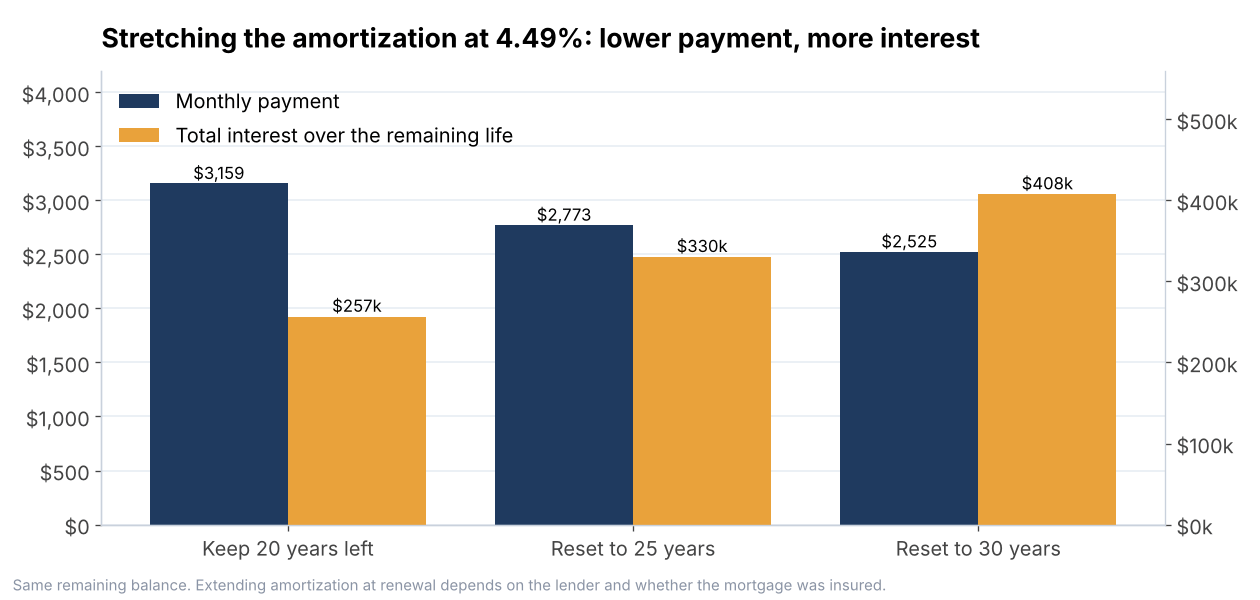
| Remaining amortization | Payment at 4.49% | Total interest from here |
|---|---|---|
| 20 years | $3,159 | about $257,000 |
| 25 years | $2,773 | about $330,000 |
| 30 years | $2,525 | about $408,000 |
Stretching is a reasonable bridge if money is tight for a few years. It's an expensive habit if you keep doing it. Whether you can extend depends on the lender, whether the mortgage was insured, and your current income.
Option 2: prepay before and during the term
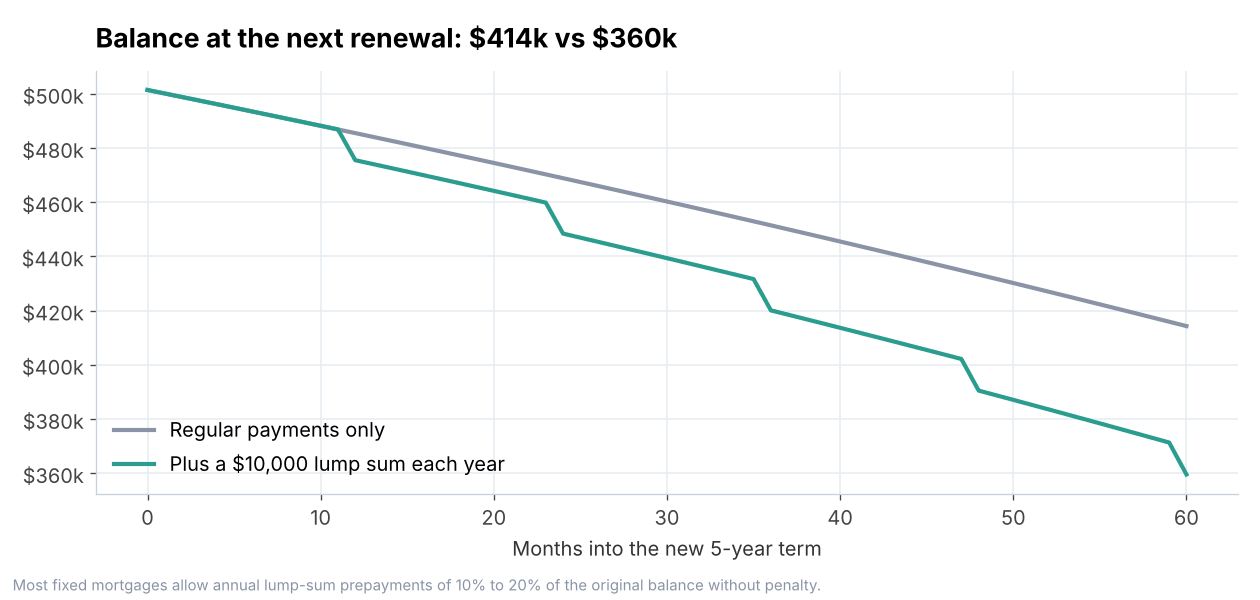
Most fixed-rate mortgages let you prepay 10% to 20% of the original balance each year without penalty, and increase the regular payment by a similar percentage. A lump sum just before renewal reduces the balance the new rate applies to.
Option 3: pick the term on purpose
At renewal you choose again between fixed and variable, and between terms from one to five years.
- A five-year fixed rate gives certainty and suits a tight budget.
- A shorter fixed term (two or three years) costs a little more today but lets you renew sooner if rates fall.
- A variable rate moves with the Bank of Canada's policy rate. Most variable mortgages can be locked into a fixed rate later, and their prepayment penalty is usually just three months' interest.
Read the Bank of Canada's recent decisions before you choose. EstateBlock's Bank of Canada rate announcement page explains each decision and what it means for variable payments and BC home prices.

Option 4: switch lenders
Your current lender's renewal offer is rarely its best rate. Since November 2024, borrowers with uninsured mortgages who switch lenders at renewal, without increasing the loan or the amortization, no longer have to pass the stress test again. Insured mortgages already had that exemption. That makes a switch much easier for households whose incomes haven't kept up with rates.
Switching usually costs little or nothing: many lenders cover the legal and discharge fees. Start comparing about 120 days before maturity, when most lenders will hold a rate.
A renewal checklist
- Note your maturity date. Lenders send the renewal letter about 21 days to four months before it.
- Get two or three quotes from a broker and other lenders, not just the renewal offer.
- Make any prepayment you can afford before the term ends.
- Decide on the amortization deliberately, knowing the interest cost.
- Don't let it auto-renew. If you do nothing, some lenders renew you into a term and rate you didn't choose.
Quick answers
Will I have to requalify at renewal? Not with your current lender. If you switch lenders and keep the same loan and amortization, you no longer have to pass the stress test.
Can I break my mortgage early to lock a rate? You can, but the penalty on a fixed mortgage can be large. Most lenders let you lock a renewal rate up to 120 days early without breaking anything.
Should I use savings to pay down the balance? If you have an emergency fund and no higher-interest debt, a prepayment at a 4% to 5% mortgage rate is a guaranteed, tax-free return.
Sources and further reading
- Financial Consumer Agency of Canada: Renewing your mortgage
- Office of the Superintendent of Financial Institutions: Guideline B-20
- Bank of Canada: Policy interest rate
Hypothetical figures. General information only, not mortgage advice.